
How Valve Actuator Design Drives Long-Term Value
In hygienic processing environments, valve reliability depends as much on the valve actuator as on the valve body itself. And in dairy, beverage, pharmaceutical and plant‑based food production, actuator performance directly influences uptime, maintenance requirements and process consistency.
As manufacturers face increasing pressure to reduce total cost of ownership, while also meeting sustainability targets, the role of actuator design in long‑term lifecycle value has become critical. High‑cycle operation, frequent cleaning‑in‑place (CIP) routines and automated production lines place continuous mechanical demands on valve actuators.
This post explains why we have extended our 5‑year warranty (or up to 1 million actuations) across our premium APV® valve actuators—and how specific actuator design choices support reliability, efficiency and confidence in real‑world hygienic processing applications.
What Is a Valve Actuator and Why Does It Matter?
A valve actuator opens, closes or positions a process valve by converting pneumatic or electric energy into controlled valve movement. In hygienic food, beverage and pharmaceutical processing, actuator performance directly affects flow control, cleaning effectiveness and line uptime. Because hygienic valves may cycle thousands of times per week, actuator design has a direct impact on maintenance frequency, energy use and total cost of ownership. Well‑engineered actuators support reliable operation, reduced downtime and predictable lifecycle value.
What Design Features Make a Valve Actuator Reliable Over Its Lifecycle?
In hygienic valve applications, long‑term reliability is not achieved through maintenance alone—it is engineered into the actuator from the start. And there are four design features that have the greatest impact on actuator lifespan, maintenance reduction and total cost of ownership in high‑cycle processing environments.
1. Fully Welded Actuator Housing
APV valve actuators use a fully welded housing, rather than a bolted or serviceable enclosure. This permanently seals internal components such as springs, pistons and seals.
Why this matters:
A welded design eliminates routine internal servicing, reduces potential failure points and lowers contamination risk—supporting hygienic integrity and consistent performance throughout the actuator’s service life.
2. Maintenance‑Free Operation
The internal components of APV actuators are engineered for long‑term operation without replacement. During the lifecycle of APV actuators, the only things that may require attention are external plastic plugs.
Why this matters:
Maintenance planning is simplified, spare‑parts inventories are reduced and technician labour requirements are minimized—without sacrificing reliability or performance.
3. Low‑Friction, Cycle‑Optimized Design
High‑quality internal sealing combined with a low‑friction mechanical design enables consistent operation under high‑cycle conditions.
Why this matters:
Reduced mechanical wear extends actuator life, supports frequent CIP cycles and product changeovers, and lowers pneumatic air consumption—contributing to operational efficiency and energy reduction.
4. Designed and Tested for 1 Million Actuations
Premium APV actuators are endurance‑tested for up to 1 million actuations, forming the technical basis of our expanded warranty offering.
Why this matters:
This rigorous testing provides confidence in long‑term performance, enables predictable asset‑life planning and delivers measurable lifecycle value.
The APV 5‑Year Valve Actuator Warranty
Our extended warranty on new APV valves equipped with premium APV actuators are a testament to rigorous testing and field experience and reflects our confidence that a fully welded, maintenance-free actuator will deliver results for up to 5-years or1 million actuations, whichever occurs first.
Covered valve ranges include:
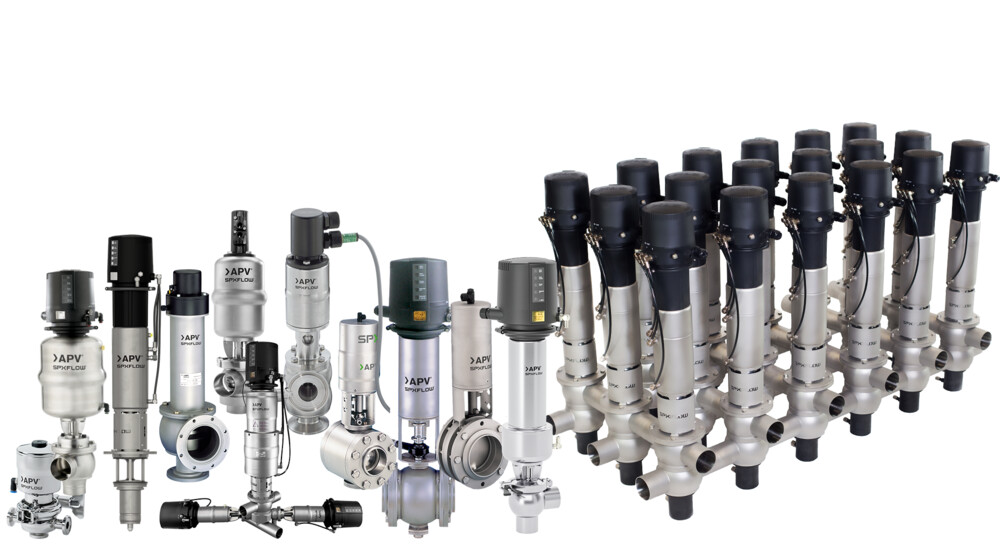
- Butterfly valves: SV, SVS
- Single‑seat valves: SW4, SWmini4
- Diaphragm valves: MS4, MSP
- Double‑seal valves: SD4, SDMS4, SWcip4
- Ball valves: BLV
- Double‑seat ball valves: UF4, DKR2
- Mix‑proof valves: D4, D4SL, DA4, DT4, DU4SL, AM1
Operational Impact Across the Plant
A maintenance‑free valve actuator delivers value that extends far beyond maintenance teams.
| Function | Impact |
|---|---|
| Maintenance | Fewer inspections, simplified planning, reduced downtime |
| Production | Improved uptime and fewer process interruptions |
| CAPEX & Plant Leadership | Lower total cost of ownership and stronger ROI |
| OEMs & System Integrators | Increased system reliability and long‑term assurance |
Sustainability Benefits of Maintenance‑Free Actuators
Our valve actuator design also impacts sustainability performance throughout the equipment lifecycle.
- Fewer replacement parts reduce material use and transport emissions
- Less packaging and shipping lowers waste and logistics impact
- Lower energy consumption through efficient pneumatic operation
- Extended service life supports circular‑economy principles by reducing waste
By minimizing interventions and material consumption, maintenance‑free actuators directly support the Reduce, Reuse, Recycle approach to sustainable processing design.
Final Thought: Why Valve Actuator Design Determines Long‑Term Value
In hygienic processing systems, valve reliability does not start with the valve body alone. It begins with the valve actuator, which controls every open, close and clean‑in‑place cycle.
A well‑engineered actuator reduces unplanned maintenance, supports consistent operation and enables predictable lifecycle cost management—especially in high‑cycle environments such as dairy, beverage, pharmaceutical and plant‑based production. Design choices such as a fully welded housing, maintenance‑free internals and low‑friction operation directly influence uptime, energy use and total cost of ownership.
The expanded 5‑year APV valve actuator warranty reflects our confidence in an actuator design built for real‑world operating conditions. It reinforces a simple principle: reliability is not assumed, it is designed, tested and supported.
When specifying new equipment or evaluating existing hygienic valve systems, one question matters above all others:
Is the valve actuator engineered for long‑term, high‑cycle operation and backed by a warranty that reflects real‑world performance?
Ours are. Get started today.