
STABLE PEANUT BUTTER PRODUCTION FROM PROCESS TO PACKAGE
Solution
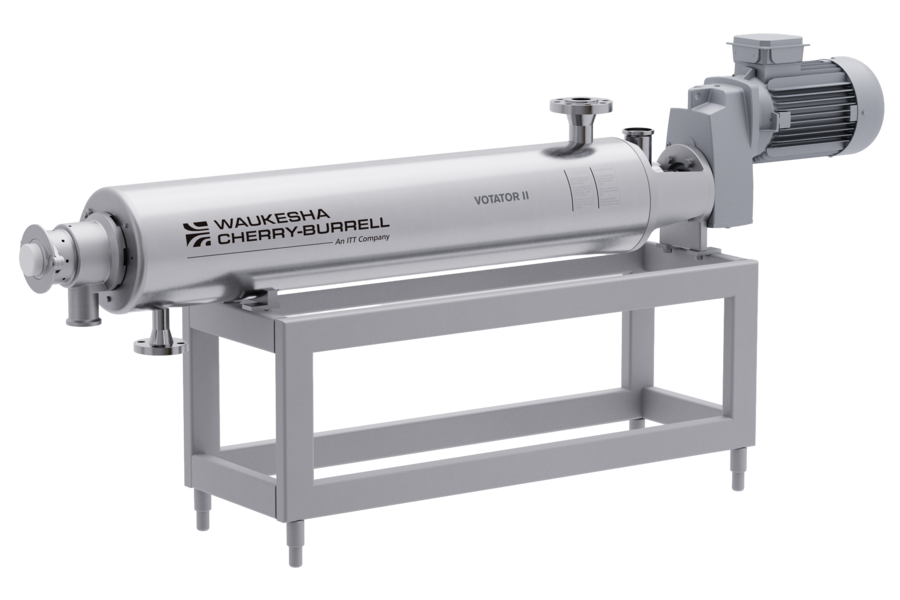
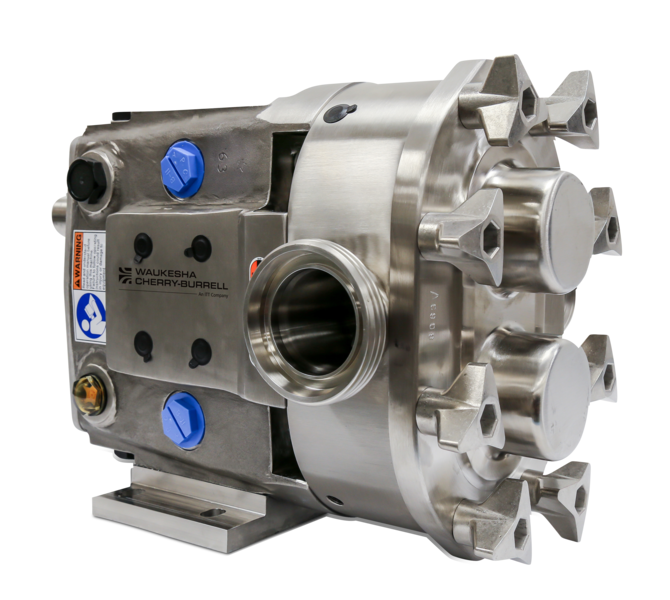
The peanut butter finishing solution combines two complementary Waukesha Cherry-Burrell technologies: the Votator II Scraped Surface Heat Exchanger and the Universal 1 ECP pump.
The Votator II uses eccentric scraper blade rotation to continuously renew the heat-transfer surface as peanut butter passes through the unit. This scraped-surface action helps:
- Improve heat transfer
- Minimize product buildup on heat-transfer surfaces
- Provide more uniform cooling
- Maintain repeatable product exit temperatures
- Support longer continuous production runs
Precise exit-temperature control is particularly important because it helps stabilize the peanut butter before packaging, reducing the potential for oil separation during storage.
The Votator II is paired with a Waukesha Cherry-Burrell Universal 1 pump, which provides smooth, predictable volumetric flow for viscous products such as peanut butter. Different pump sizes can be selected for individual duties, with one pump providing stable feed into the finishing stage and another transferring finished product toward packaging based on the line configuration and required capacity.
Together, the technologies help maintain consistent residence time, temperature control and gentle product handling throughout the finishing process.
Result
The combination of scraped-surface cooling and controlled product transfer provides peanut butter processors with a stable finishing process designed for continuous production.
- Reduced Oil Separation: Consistent exit-temperature control helps limit oil migration during storage and improves finished-product stability.
- Consistent Product Quality: Uniform cooling helps processors maintain repeatable texture and appearance from batch to batch.
- Stable Product Flow: Universal 1 pumps provide predictable volumetric flow through the heat exchanger and onward to packaging.
- Reduced Buildup: Continuous scraping of the heat-transfer surface helps minimize fouling, common with highly viscous peanut butter.
- Lower Downtime and Maintenance: Reduced fouling can decrease cleaning interruptions and maintenance requirements during extended production runs.
- Scalable Production: The combined Votator II and Universal 1 system provides a reliable approach for continuous, high-throughput peanut butter processing
Learn more about Waukesha Cherry-Burrell Votator solutions
Votator II Scraped Surface Heat Exchanger