
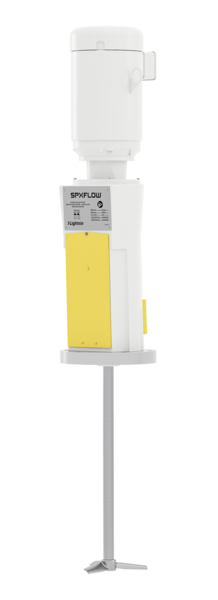
How to Process Natural Food Colors
Mixing Solutions for Consistent, Clean-Label Results
Supporting major food and beverage manufacturers in the shift away from synthetic dyes with tailored mixing solutions.
The Shift to Natural Food Colors Is Accelerating
As consumers demand cleaner labels and more transparent ingredient lists, manufacturers are rapidly moving away from synthetic dyes like Red 40 in favor of natural food colorants derived from fruits, vegetables and botanicals.
But while the label may be simpler, the process is not.
Natural color systems introduce new complexities in dispersion, stability and consistency, making mixing technology a critical factor in successful reformulation.
Why Natural Food Color Processing Is More Challenging
Compared to synthetic dyes, natural pigments are far more sensitive to processing conditions. Common challenges include:
- Shear sensitivity → pigment degradation and color loss
- Poor dispersion → streaking or uneven appearance
- Settling and separation → inconsistent product quality
- Sensitivity to heat and pH → instability during processing
Without the right mixing approach, these challenges can lead to:
- Batch variability
- Increased waste and rework
- Reduced shelf life
- Inconsistent consumer experience
How Advanced Mixing Solves Natural Color Challenges
To achieve consistent, vibrant results, manufacturers must carefully control how ingredients are introduced, dispersed and maintained throughout processing.
Advanced mixing solutions play a critical role by addressing the unique sensitivities of natural pigments.
- Controlled Shear for Pigment Protection
Proper impeller selection ensures pigments are evenly dispersed without damaging their structure. - Uniform Dispersion of Natural Colorants
Optimized flow patterns eliminate clumping and ensure consistent color throughout the product. - Suspension Stability
Continuous agitation prevents settling of particulate-based colorants during processing and storage. - Scalable, Repeatable Performance
From pilot to full-scale production, mixing solutions ensure consistent results across every batch.
Related Brand
Industrial mixing technologies for reliable process performance and efficiency.
PhiladelphiaIndustrial mixing and agitation technologies for demanding applications.
PlentyIndustrial mixing solutions for efficient tank blending and fluid motion.
StelzerHygienic mixing technologies for pharmaceutical and biotech processing.
UutechnicAeration and wastewater treatment technologies for efficient process performance.
 Preserving Natural Food Colors with Evaporators
 Reducing Pressure Drop in Meat & Pet Food Processing